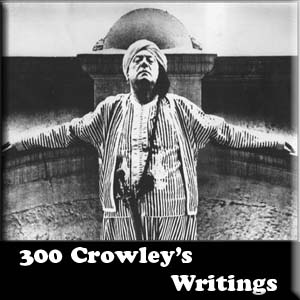
Night Of Pan In Writings Of Crowley

Night Of Pan In Writings Of Crowley Cover Aleister Crowley identifies this process as one of Love. He explains in Little Essays Towards Truth:

The truly magical operations of Love are therefore the Trances, more especially those of Understanding; as will readily have been appreciated by those who have made a careful Qabalistic study of the nature of Binah. For she is omniform as Love and as Death, the Great Sea whence all Life springs, and whose black womb reabsorbs all. She thus resumes in herself the duplex process of the Formula of Love under Will; for is not Pan the All-Begetter in the heart of the Groves at high noon, and is not Her "hair the trees of Eternity" the filaments of All-Devouring Godhead "under the Night of Pan?"

It is also described in the mystical text Liber VII:

Ascend in the flame of the pyre, O my soul! Thy God is like the cold emptiness of the utmost heaven, into which thou radiatest thy little light.
When Thou shall know me, O empty God, my flame shall utterly expire in Thy great N. O. X.
—Liber Liberi vel Lapdis Lazuli, I:39-40

Finally, Crowley writes of the Night of Pan in his The Book of Lies, in the chapter "Sabbath of the Goat":

O! the heart of N.O.X. the Night of Pan.
PAN: Duality: Energy: Death.
Death: Begetting: the supporters of O!
To beget is to die; to die is to beget.
Cast the Seed into the Field of Night.
Life and Death are two names of A.
Kill thyself.
Neither of these alone is enough.

In his Commentary on this writing, Crowley explains:

It is explained that this triad lives in Night, the Night of Pan, which is mystically called N.O.X., and this O is identified with the O in this word. N is the Tarot symbol, Death; and the X or Cross is the sign of the Phallus. NOX adds to 210, which symbolizes the reduction of duality to unity, and thence to negativity, and is thus a hieroglyph of the Great Work.

The word Pan is then explained, {Pi}, the letter of Mars, is a hieroglyph of two pillars, and therefore suggest duality; A, by its shape, is the pentagram, energy, and N, by its Tarot attribution, is death. NOX is then further explained, and it is shown that the ultimate Trinity, O!, is supported, or fed, by the process of death and begetting, which are the laws of the universe...It is then asserted that the ultimate letter A has two names, or phases, Life and Death.

Free eBooks (Can Be Downloaded):

Ross Arthur - English Old Norse Dictionary
Saint John Of The Cross - Dark Night Of The Soul
Thomas Voxfire - What Was Aleister Crowley
Will Herberg - The Writings Of Martin Buber
Anonymous - The Book Of Dagon Cursed Writings Of Assyrian Priests

Language Shapes Our Reality

Language Shapes Our Reality Image
Does language shape reality, or does reality determine language? Four new articles on four different sites suggest that how we experience the world is determined by the language we speak and with which we think.

I'm offering just a bit of each article -please follow the title link to see the whole article.

LOST IN TRANSLATION


New Cognitive Research Suggests That Language Profoundly Influences The Way People See The World; A Different Sense Of Blame In Japanese And Spanish

By LERA BORODITSKY


The Gallery Collection/Corbis: 'The Tower of Babel' by Pieter Brueghel the Elder, 1563.

Do the languages we speak shape the way we think? Do they merely express thoughts, or do the structures in languages (without our knowledge or consent) shape the very thoughts we wish to express?

Take "Humpty Dumpty sat on a..." Even this snippet of a nursery rhyme reveals how much languages can differ from one another. In English, we have to mark the verb for tense; in this case, we say "sat" rather than "sit." In Indonesian you need not (in fact, you can't) change the verb to mark tense.

In Russian, you would have to mark tense and also gender, changing the verb if Mrs. Dumpty did the sitting. You would also have to decide if the sitting event was completed or not. If our ovoid hero sat on the wall for the entire time he was meant to, it would be a different form of the verb than if, say, he had a great fall.

In Turkish, you would have to include in the verb how you acquired this information. For example, if you saw the chubby fellow on the wall with your own eyes, you'd use one form of the verb, but if you had simply read or heard about it, you'd use a different form.

Do English, Indonesian, Russian and Turkish speakers end up attending to, understanding, and remembering their experiences differently simply because they speak different languages?

* * * * *

LOST IN TRANSLATION


"We don't shape language, language shapes us" by Joan O'C. Hamilton, from Stanford - September-October 2010

Image Gallery Linzie Hunter / www.linziehunter.co.uk

Lera Boroditsky's journey to answer one of psychology's most intriguing and fractious questions has been a curious one. She's spent hours showing Spanish speakers videos of balloons popping, eggs cracking, and paper ripping. She's scoured campuses for Russian speakers willing to spend an hour sorting shades of blue. She's even traipsed to a remote aboriginal village in Australia where small children shook their heads at what they considered her pitiable sense of direction and took her hand to show her how to avoid being gobbled by a crocodile. Yet she needs little more than a teacup on her office coffee table to explain the essence of her research.

"In English," she says, moving her hand toward the cup, "if I knock this cup off the table, even accidentally, you would likely say, 'She broke the cup.' " In Japanese or Spanish, however, intent matters, she explains.

If one deliberately knocks the cup, there is a verb form to indicate as much. But if the act were an accident, Boroditsky says, a smile dancing across her lips as she translates from Spanish, the speaker would essentially say, "The cup broke itself."The question is: Does the fact that one language tends to play the blame game while the other does not mean that speakers of those languages think differently about what happened?* * * * *

DOES YOUR LANGUAGE SHAPE HOW YOU THINK?

Horacio Salinas for The New York Times


By GUY DEUTSCHER

Published: August 26, 2010

SEVENTY YEARS AGO, IN 1940, A POPULAR SCIENCE MAGAZINE PUBLISHED A SHORT ARTICLE THAT SET IN MOTION ONE OF THE TRENDIEST INTELLECTUAL FADS OF THE 20TH CENTURY. At first glance, there seemed little about the article to augur its subsequent celebrity. Neither the title, "Science and Linguistics," nor the magazine, M.I.T.'s Technology Review, was most people's idea of glamour. And the author, a chemical engineer who worked for an insurance company and moonlighted as an anthropology lecturer at Yale University, was an unlikely candidate for international superstardom. And yet Benjamin Lee Whorf let loose an alluring idea about language's power over the mind, and his stirring prose seduced a whole generation into believing that our mother tongue restricts what we are able to think.

In particular, Whorf announced, Native American languages impose on their speakers a picture of reality that is totally different from ours, so their speakers would simply not be able to understand some of our most basic concepts, like the flow of time or the distinction between objects (like "stone") and actions (like "fall"). For decades, Whorf's theory dazzled both academics and the general public alike. In his shadow, others made a whole range of imaginative claims about the supposed power of language, from the assertion that Native American languages instill in their speakers an intuitive understanding of Einstein's concept of time as a fourth dimension to the theory that the nature of the Jewish religion was determined by the tense system of ancient Hebrew.

Eventually, Whorf's theory crash-landed on hard facts and solid common sense, when it transpired that there had never actually been any evidence to support his fantastic claims. The reaction was so severe that for decades, any attempts to explore the influence of the mother tongue on our thoughts were relegated to the loony fringes of disrepute. But 70 years on, it is surely time to put the trauma of Whorf behind us. And in the last few years, new research has revealed that when we learn our mother tongue, we do after all acquire certain habits of thought that shape our experience in significant and often surprising ways.

Whorf, we now know, made many mistakes. The most serious one was to assume that our mother tongue constrains our minds and prevents us from being able to think certain thoughts. The general structure of his arguments was to claim that if a language has no word for a certain concept, then its speakers would not be able to understand this concept. If a language has no future tense, for instance, its speakers would simply not be able to grasp our notion of future time. It seems barely comprehensible that this line of argument could ever have achieved such success, given that so much contrary evidence confronts you wherever you look. When you ask, in perfectly normal English, and in the present tense, "Are you coming tomorrow?" do you feel your grip on the notion of futurity slipping away? Do English speakers who have never heard the German word "Schadenfreude" find it difficult to understand the concept of relishing someone else's misfortune? Or think about it this way: If the inventory of ready-made words in your language determined which concepts you were able to understand, how would you ever learn anything new?

SINCE THERE IS NO EVIDENCE that any language forbids its speakers to think anything, we must look in an entirely different direction to discover how our mother tongue really does shape our experience of the world. Some 50 years ago, the renowned linguist Roman Jakobson pointed out a crucial fact about differences between languages in a pithy maxim: "Languages differ essentially in what they "must" convey and not in what they "may" convey." This maxim offers us the key to unlocking the real force of the mother tongue: if different languages influence our minds in different ways, this is not because of what our language "allows" us to think but rather because of what it habitually "obliges" us to think "about".

Consider this example. Suppose I say to you in English that "I spent yesterday evening with a neighbor." You may well wonder whether my companion was male or female, but I have the right to tell you politely that it's none of your business. But if we were speaking French or German, I wouldn't have the privilege to equivocate in this way, because I would be obliged by the grammar of language to choose between "voisin" or "voisine"; "Nachbar" or "Nachbarin". These languages compel me to inform you about the sex of my companion whether or not I feel it is remotely your concern. This does not mean, of course, that English speakers are unable to understand the differences between evenings spent with male or female neighbors, but it does mean that they do not have to consider the sexes of neighbors, friends, teachers and a host of other persons each time they come up in a conversation, whereas speakers of some languages are obliged to do so.

On the other hand, English does oblige you to specify certain types of information that can be left to the context in other languages. If I want to tell you in English about a dinner with my neighbor, I may not have to mention the neighbor's sex, but I do have to tell you something about the timing of the event: I have to decide whether we "dined", "have been dining", "are dining", "will be dining" and so on. Chinese, on the other hand, does not oblige its speakers to specify the exact time of the action in this way, because the same verb form can be used for past, present or future actions. Again, this does not mean that the Chinese are unable to understand the concept of time. But it does mean they are not obliged to think about timing whenever they describe an action.

When your language routinely obliges you to specify certain types of information, it forces you to be attentive to certain details in the world and to certain aspects of experience that speakers of other languages may not be required to think about all the time. And since such habits of speech are cultivated from the earliest age, it is only natural that they can settle into habits of "mind" that go beyond language itself, affecting your experiences, perceptions, associations, feelings, memories and orientation in the world.

BUT IS THERE any evidence for this happening in practice?

Let's take genders again. Languages like Spanish, French, German and Russian not only oblige you to think about the sex of friends and neighbors, but they also assign a male or female gender to a whole range of inanimate objects quite at whim. What, for instance, is particularly feminine about a Frenchman's beard ("la barbe")? Why is Russian water a she, and why does she become a he once you have dipped a tea bag into her? Mark Twain famously lamented such erratic genders as female turnips and neuter maidens in his rant "The Awful German Language." But whereas he claimed that there was something particularly perverse about the German gender system, it is in fact English that is unusual, at least among European languages, in not treating turnips and tea cups as masculine or feminine. Languages that treat an inanimate object as a he or a she force their speakers to talk about such an object as if it were a man or a woman. And as anyone whose mother tongue has a gender system will tell you, once the habit has taken hold, it is all but impossible to shake off. When I speak English, I may say about a bed that "it" is too soft, but as a native Hebrew speaker, I actually feel "she" is too soft. "She" stays feminine all the way from the lungs up to the glottis and is neutered only when she reaches the tip of the tongue.

In recent years, various experiments have shown that grammatical genders can shape the feelings and associations of speakers toward objects around them. In the 1990s, for example, psychologists compared associations between speakers of German and Spanish. There are many inanimate nouns whose genders in the two languages are reversed. A German bridge is feminine ("die Br"ucke"), for instance, but "el puente" is masculine in Spanish; and the same goes for clocks, apartments, forks, newspapers, pockets, shoulders, stamps, tickets, violins, the sun, the world and love. On the other hand, an apple is masculine for Germans but feminine in Spanish, and so are chairs, brooms, butterflies, keys, mountains, stars, tables, wars, rain and garbage. When speakers were asked to grade various objects on a range of characteristics, Spanish speakers deemed bridges, clocks and violins to have more "manly properties" like strength, but Germans tended to think of them as more slender or elegant. With objects like mountains or chairs, which are "he" in German but "she" in Spanish, the effect was reversed.

In a different experiment, French and Spanish speakers were asked to assign human voices to various objects in a cartoon. When French speakers saw a picture of a fork ("la fourchette"), most of them wanted it to speak in a woman's voice, but Spanish speakers, for whom "el tenedor" is masculine, preferred a gravelly male voice for it. More recently, psychologists have even shown that "gendered languages" imprint gender traits for objects so strongly in the mind that these associations obstruct speakers' ability to commit information to memory.

* * * * *

This article is presented whole since it is essentially a press release:

LANGUAGE APPEARS TO SHAPE OUR IMPLICIT PREFERENCES


Study Of Bilinguals Hints Language May Help Create, Not Just Convey, Thoughts And Feelings

CAMBRIDGE, Mass., Nov. 3, 2010 -- The language we speak may influence not only our thoughts, but our implicit preferences as well. That's the finding of a study by psychologists at Harvard University, who found that bilingual individuals' opinions of different ethnic groups were affected by the language in which they took a test examining their biases and predilections.

The paper appears in the "Journal of Experimental Social Psychology".

"Charlemagne is reputed to have said that to speak another language is to possess another soul," says co-author Oludamini Ogunnaike, a graduate student at Harvard. "This study suggests that language is much more than a medium for expressing thoughts and feelings. Our work hints that language creates and shapes our thoughts and feelings as well."

Implicit attitudes, positive or negative associations people may be unaware they possess, have been shown to predict behavior towards members of social groups. Recent research has shown that these attitudes are quite malleable, susceptible to factors such as the weather, popular culture -- or, now, by the language people speak.

"Can we shift something as fundamental as what we like and dislike by changing the language in which our preferences are elicited?" asks co-author Mahzarin R. Banaji, the Richard Clarke Cabot Professor of Social Ethics at Harvard. "If the answer is yes, that gives more support to the idea that language is an important shaper of attitudes."

Ogunnaike, Banaji, and Yarrow Dunham, now at the University of California, Merced, used the well-known Implicit Association Test (IAT), where participants rapidly categorize words that flash on a computer screen or are played through headphones. The test gives participants only a fraction of a second to categorize words, not enough to think about their answers.

"The IAT bypasses a large part of conscious cognition and taps into something we're not aware of and can't easily control," Banaji says.

The researchers administered the IAT in two different settings: once in Morocco, with bilinguals in Arabic and French, and again in the U.S. with Latinos who speak both English and Spanish.

In Morocco, participants who took the IAT in Arabic showed greater preference for other Moroccans. When they took the test in French, that difference disappeared. Similarly, in the U.S., participants who took the test in Spanish showed a greater preference for other Hispanics. But again, in English, that preference disappeared.

"It was quite shocking to see that a person could take the same test, within a brief period of time, and show such different results," Ogunnaike says. "It's like asking your friend if he likes ice cream in English, and then turning around and asking him again in French and getting a different answer."

In the Moroccan test, participants saw "Moroccan" names (such as Hassan or Fatimah) or "French" names (such as Jean or Marie) flash on a monitor, along with words that are "good" (such as happy or nice) or "bad" (such as hate or mean). Participants might press one key when they see a Moroccan name or a good word, and press another when they see a French name or a bad word. Then the key assignments are switched so that "Moroccan" and "bad" share the same key and "French" and "good" share the other.

Linguist Benjamin Lee Whorf first posited in the 1930s that language is so powerful that it can determine thought. Mainstream psychology has taken the more skeptical view that while language may affect thought processes, it doesn't influence thought itself. This new study suggests that Whorf's idea, when not caricatured, may generate interesting hypotheses that researchers can continue to test.

"These results challenge our views of attitudes as stable," Banaji says. "There still remain big questions about just how fixed or flexible they are, and language may provide a window through which we will learn about their nature." ###

Ogunnaike, Dunham, and Banaji's work was supported by Harvard's Weatherhead Center for International Affairs and the Mellon Mays Foundation.

Tags: Psychology, brain, language, perspectives, bilingual, preferences, thought, mind, consciousness, Benjamin Lee Whorf, Roman Jakobson, Lera Boroditsky, Joan O'C. Hamilton, Lost in Translation

Suggested ebooks:

Aleister Crowley - Songs For Italy
Richard Weiss - Recipes For Immortality


Keywords: astral projection herbs  astral travel hypnosis  my guardian angels  astral project  the grimoire  how to do astral projection  astral travels  michael jackson aleister crowley  the god of the witches  egyptian mythology  

Magick Fluid Condenser

Magick Fluid Condenser Cover
Magic fluid condensers are designed to expand or release at a certain time, some of the forces behind a spell.

There are three principle groups of condensers:


1. The 'solid' fluid condensers are metals and resins. Gold is the highest force. Human blood and sperm may be substitute for gold.
2. Extracts from resins including lacquers, oils and tinctures.
3. Least important are smelling waters and evaporations. Useful for making up bulk.

There are two types of fluid condensers:


1. Simple - made from one material or one plant.
2. Compound – made from blending and mixing several materials and/or plants.

A tiny amount of gold is needed in both types. One gram of gold chloride diluted in 20 grams of distilled water produces a gold tincture. Five to ten drops of gold tincture are needed for 100 grams of fluid condenser.

SIMPLE FLUID CONDENSER


Put a handful of fresh or dried Chamomile flowers in a pot (preferably not metal) and cover with water. Boil for 20 minutes. Let cool with lid on pot.

When cold, strain through fine linen. Return liquid to pot and boil again for 20 minutes. Cool and mix with an equal amount of fuel alcohol or spirit of alcohol.

Add 20 drops of gold tincture. If the condenser will be used especially for your own interests, add one drop of your own blood or sperm.

Place liquid in a dark bottle, well corked or sealed, and store in a dark place.

In place of Chamomile flowers, you might use white lily flowers, poplar leaves, acacia flowers, etc.

COMPOUND FLUID CONDENSER


Angelica
Sage
Lime tree flowers
Cucumber skin
Melon seeds
Tobacco, green or dried
Chamomile or lily flowers, leaves or roots
Cinnamon bark or flowers
Violet ordorata, leave or flowers
Willow, leaves or bark

Take equal parts of all ingredients and place in a large earthenware pot. Cover with water and boil slowly for 30 minutes. Cool and strain, then boil again.

Cool, and add an equal amount of spirit of alcohol. Add 10 drops of tincture of gold to every 100 grams of liquid. Add 5 drops of blood or sperm or 5 drops of each.

Strain through fine linen, bottle and cork. Store in a dark place.

ALTERNATE METHOD (Compound condenser)

Place all leaves and seeds in a very large pot. Cover with alcohol and leave in a warm place for 28 days. Pass through linen filter, add gold tincture, and your won blood or sperm. Fluid condensers are added power to the spell.

There are four systems of influencing people:


1. FIRE – influence through combustion
2. AIR – influence through evaporation
3. WATER – influence through mixture
4. EARTH – influence through decomposition

To influence a human - EARTH
Drive to a special goal - FIRE
Romantic vision/union - WATER
All matters of the mind - AIR
Greater spirituality - WATER

(Most spells must be renewed)

USE OF FLUID CONDENSERS


FIRE ELEMENT


Take a piece of blotter paper or linen, moisten with either condenser, then place it in front of you and concentrate on what you wish to accomplish. Load the paper or linen with your desire until you find your concentration breaking. Then burn it. While it is burning, concentrate on your desire again. The power of your concentration and the condenser are released by burning. Turn the problem over to the Universal element and discard the ashes.

AIR ELEMENT


Take a metal container (an ashtray will do) and pour in enough water to cover the bottom. Add a few drops of condenser. Concentrate on your desire as you look into the liquid. Put the container on a stove and let the desire-loaded liquid evaporate. As you concentrate on the steam, wish your desire to be taken in the air element. Continue thusly until all the liquid is gone. Very good for respiratory troubles or for the better health of a friend.

WATER ELEMENT


Take a new unused container (glass – no plastic) and fill with water, bottles, spring or rain water is best. Add a few drops of condenser (use compound only in a real emergency). Fill the water element with your wish or desire. When concentration breaks, the water has been loaded. Now throw the liquid into a river as you think how happy you are that your desire has been absorbed by the Water element, and that part of its power is released with your wish.

EARTH ELEMENT


There are two methods, rain water may be put into a bottle with the condenser or the condenser can be poured directly on the ground. Concentration (loading) must be done first. Liquid should be poured where people will not be walking. A flower pot of earth may b used, or make a hole in a large apple or potato and pour the condenser into it, then bury it in the ground or flower pot. Concentration should continue through each operation.

(by Sybil Leek)


Suggested ebooks:

Carroll Runyon - Magick And Hypnosis
Kelly Link - Magic For Beginners
Samael Aun Weor - Magic Runes

Keywords: three characteristics  rituals spell magic  helpful hints  magick liber  better society  book perfection  magick karma rule  book lies  beliefs rituals wiccan  scripts cipher alphabets  aleister crowley michael jackson  

Rodin In Rime

Rodin In Rime Cover

Book: Rodin In Rime by Aleister Crowley

Contains seven lithographs executed by Auguste Clot after the original sketches with water-colors of Auguste Rodin which were presented to Crowley during a visit in 1903.
It's said that many of these books were destroyed or damaged due to a flood that occurred in a warehouse where they were being stored prior to sale.
Title page and dedication page printed in black and red.

While other defenders of Rodin were apologizing for him in detail I brushed aside the nonsense-"a plague o' both your houses!" - and wrote a sonnet, which is, in its way, to conventional criticism exactly what the Balzac was. It was translated into French by Marcel Schwob and made considerable stir in Paris. Even at this length of time, I attach a certain importance to it. For one thing, it marks a new stage in my own art.

The upshot was that Rodin invited me to come and stay with him at Meudon. The idea was that I should give a poetic interpretation of all his masterpieces. I produced a number of poems, many of which I published at the time in the Weekly Critical Review, an attempt to establish an artistic entente cordiale. The entire series constitutes my Rodin in Rime. This book is illustrated by seven often lithographs of sketches which Rodin gave me for the purpose.
- The Confessions of Aleister Crowley. New York, NY. Hill and Wang, 1969. Page 340.

Download Aleister Crowley's eBook: Rodin In Rime

Books in PDF format to read:

Howard Phillips Lovecraft - The Disinterment
Hellmut Ritter - Picatrix In German
Aleister Crowley - Rosa Inferni
Howard Phillips Lovecraft - Necronomicon In German
Aleister Crowley - Rodin In Rime

Blogger Theme by BloggerThemes & ChethstudiosDesign by Metalab
Copyright © Thelema and Faith