skip to main |
skip to sidebar
Through history there have been many secret societies and conspiracy theories about those societies. This is a list of 10 of the most famous and popular secret societies or alleged secret societies.
1. Skull and Bones
Members of the Skull and Bones (George Bush is left of the clock) [1947]
The Order of Skull and Bones, a Yale University society, was originally known as the Brotherhood of Death. It is one of the oldest student secret societies in the United States. It was founded in 1832 and membership is open to an elite few. The society uses masonic inspired rituals to this day. Members meet every Thursday and Sunday of each week in a building they call the "Tomb".
According to Judy Schiff, Chief Archivist at the Yale University Library, the names of the members were not kept secret until the 1970s, but the rituals always have been. Both of the Bush presidents were members of the society while studying at Yale, and a number of other members have gone on to great fame and fortune.
The society is surrounded by conspiracy theories; the most popular of which is probably the idea that the CIA was built on members from the group. The CIA released a statement in 2007 (coinciding with the popularity of the film The Good Shepherd) in which it denied that the group was an incubator for the CIA.
2. Freemasons
Freemasons Annual Meeting [1992]
The Grand Masonic Lodge was created in 1717 when four small groups of lodges joined together. Membership levels were initially first and second degree, but in the 1750s this was expanded to create the third degree which caused a split in the group. When a person reaches the third degree, they are called a Master Mason.
Masons conduct their regular meetings in a ritualized style. This includes many references to architectural symbols such as the compass and square. They refer to God as "The Great Architect of the Universe". The three degrees of Masonry are: 1: Entered Apprentice, this makes you a basic member of the group. 2: Fellow Craft, this is an intermediate degree in which you are meant to develop further knowledge of Masonry. 3: Master Mason, this degree is necessary for participating in most masonic activities. Some rites (such as the Scottish rite) list up to 33 degrees of membership.
Masons use signs and handshakes to gain admission to their meetings, as well as to identify themselves to other people who may be Masons. The signs and handshakes often differ from one jurisdiction to another and are often changed or updated. This protects the group from people finding out how to gain admission under false pretenses. Masons also wear stylized clothing based upon the clothing worn by stone masons from the middle ages. The most well known of these is the apron.
In order to become a Mason, you must generally be recommended by a current mason. In some cases you must be recommended three times before you can join. You have to be at least 18 years old and of sound mind. Many religions frown upon membership of the Masons, and the Roman Catholic Church forbids Catholics to join under pain of excommunication.
3. Rosicrucians
Secret Symbols of the Rosicrucians
The Rosicrucian order is generally believed to have been the idea of a group of German protestants in the 1600s when a series of three documents were published: Fama Fraternitatis Rosae Crucis, Confessio Fraternitatis, and The Chymical Wedding of Christian Rosenkreutz anno 1459. The documents were so widely read and influential, that the historian Frances Yeats refers to the 17th century as the Rosicrucian Enlightenment. The first document tells the story of a mysterious alchemist (Christian Rosenkreuz) who travelled to various parts of the world gathering secret knowledge. The second document tells of a secret brotherhood of alchemists who were preparing to change the political and intellectual face of Europe. The third document describes the invitation of Christian Rosenkreuz to attend and assist at the "Chemical" wedding of a King and Queen in a castle of Miracles.
Current members of the Rosicrucian Order claim that its origins are far more ancient than these documents. The authors of the documents seemed to strongly favor Lutheranism and include condemnations of the Catholic Church. Rosicrucianism probably had an influence on Masonry and, in fact, the 18th degree of Scottish Rite Masonry is called the Knight of the Rose Croix (red cross).
There are a large number of Rosicrucian groups today - each claiming to be closely tied to the original. Of the two main divisions, one is a mix of Christianity with Rosicrucian principles, and the other is semi-Masonic. The Masonic type tend to also have degrees of membership.
4. Ordo Templis Orientis
Crowley with OTO Instruments
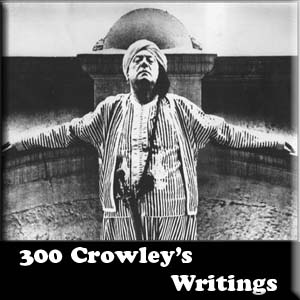
The OTO (Order of the Temples of the East) is an organization that was originally modeled on Masonry but, under the leadership of the self-styled "Great Beast" Aleister Crowley, it took on the principles of his religious system called Thelema. Thelema is based around a single law: "Do what thou wilt shall be the whole of the law, love is the law, love under the will" [1904]. Membership is based upon degrees of initiation and highly stylized rituals are used. The OTO currently claims over 3,000 members worldwide.
Crowley created a "Mass" for the OTO which is called the Gnostic Mass. Of the "Mass", Crowley wrote:
"I resolved that my Ritual should celebrate the sublimity of the operation of universal forces without introducing disputable metaphysical theories. I would neither make nor imply any statement about nature which would not be endorsed by the most materialistic man of science. On the surface this may sound difficult; but in practice I found it perfectly simple to combine the most rigidly rational conceptions of phenomena with the most exalted and enthusiastic celebration of their sublimity."
The ritual is very stylized and uses virgin priestesses, children, and priests. Many Ancient Egyptian God's are invoked, as well as the Devil, and at one point the priestess performs a naked ritual.
5. Hermetic Order of The Golden Dawn
Golden Dawn Symbolism
The order of the Golden Dawn was created by Dr. William Robert Woodman, William Wynn Westcott, and Samuel Liddell MacGregor Mathers. All three were Freemasons and members of Societas Rosicruciana in Anglia (an organization with ties to Masonry). It is considered by many to be a forerunner of the Ordo Templi Orientis and a majority of modern Occult groups.
The belief system of the Golden Dawn is largely taken from Christian mysticism, Qabalah, Hermeticism, the religion of Ancient Egypt, Freemasonry, Alchemy, Theosophy, Magic, and Renaissance writings. William Yeats, and Aleister Crowly are two of the more famous members of the group.
The fundamental documents of the order are known as the Cipher Documents. These were translated into English using a cipher attributed to Johannes Trithemius. The documents are a series of 60 folios containing magic rituals. The basic structure of many of these rituals appear to originate with Rosicrucianism. There is a great deal of controversy surrounding the origins of these documents.
6. The Knights Templar
Mediaeval Templar's Sword
The Knights Templar (full name: The United Religious, Military and Masonic Orders of the Temple and of St John of Jerusalem, Palestine, Rhodes and Malta) is a modern off-shoot of Masonry and does not have a direct tie to the original Knights Templar - a religious military group formed in the 12th century. Members of the Masonic Knights Templar do not claim a direct connection to the medieval group, but merely a borrowing of ideas and symbols.
In order to become a member of this group, you must already be a Christian Master Mason. This organization is a distinct one, and is not just a higher degree of Masonry. Despite Freemasonry's general disclaimer that no one Masonic organization claims a direct heritage to the medieval Knights Templar, certain degrees and orders are obviously patterned after the medieval Order. These are best described as "commemorative orders" or degrees. Nevertheless, in spite of the fraternity's official disclaimers, some Masons, non-Masons, and even anti-Masons insist that certain Masonic rites or degrees originally had direct Templar influence.
7. The Illuminati
The Pyramid, an illuminati symbol
A movement of freethinkers that were the most radical offshoot of The Enlightenment - whose followers were given the name Illuminati (but who called themselves "Perfectibilists") - was founded on May 1, 1776 in Ingolstadt (Upper Bavaria), by Jesuit-taught Adam Weishaupt. This group is now known as the Bavarian Illuminati. While it was not legally allowed to operate, many influential intellectuals and progressive politicians counted themselves as members. Even though there were some known Freemasons in the membership, it was not considered to be endorsed by Masonry. The fact that the Illuminati did not require a belief in a supreme being made them particularly popular amongst atheists. This, and the fact that most members were humanists, is the reason for the widespread belief that the Illuminati wants to overthrow organized religion.
Internal panic over the succession of a new leader, and government attempts to outlaw the group saw to it collapsing entirely in the late 1700s. Despite this, conspiracy theorists such as David Icke and Was Penre, have argued that the Bavarian Illuminati survived, possibly to this day, though very little reliable evidence can be found to support the idea that Weishaupt's group survived into the 19th century. It has even been suggested that the Skull and Bones club is an American branch of the Illuminati.
Many people believe that the Illuminati is still operating and managing the main actions of the governments of the world. It is believed that they wish to create a One World Government based on humanist and atheist principles.
8. The Bilderberg Group
A Bilderberg Meeting
This group is slightly different from the others in that it does not have an official membership. It is the name given to a group of highly influential people who meet ever year in secrecy (and usually with strong military and government sponsored security). The topics discussed are kept secret. The structure of the meetings is that of a conference - usually held in five star hotels around the world. Attendance at the meeting is strictly by invitation only. The first meeting took place in 1954 at the Hotel Bilderberg in the Netherlands.
The original meeting was initiated by several people. Polish emigre and political adviser, Joseph Retinger, concerned about the growth of anti-Americanism in Western Europe, proposed an international conference at which leaders from European countries and the United States would be brought together with the aim of promoting understanding between the cultures of The United States of America and Western Europe.
Although the agenda and list of participants are openly available to the public, it is not clear that such details are disclosed by the group itself. Also, the contents of the meetings are kept secret and attendees pledge not to divulge what was discussed. The group's stated justification for secrecy is that it enables people to speak freely without the need to carefully consider how every word might be interpreted by the mass media.
Needless to say, this group is constantly surrounded by controversy and conspiracy theories.
9. The Priory of Sion
Logo of the Priori of Sion
After the publication of the Da Vinci Code by Dan Brown, a great deal of interest in the Priory of Sion has been created. Unfortunately for those hoping to find and join the Priory, it is, in fact, fictional. It was a hoax created in 1956 by a pretender to the French Throne, Pierre Plantard. Letters in existence dating from the 1960s written by Plantard, de Cherisey and de S`ede to each other confirm that the three were engaging in an out-and-out confidence trick, describing schemes on how to combat criticisms of their various allegations and how they would make up new allegations to try to keep the whole thing going. Despite this, many people still continue to believe that the Priory exists and functions to this day.
The authors of the well known book, The Holy Blood and the Holy Grail, misled by the hoax, stated:
1. The Priory of Sion has a long history starting in AD 1099, and had illustrious Grand Masters including Isaac Newton and Leonardo da Vinci.
2. The order protects certain royal claimants because they believe them to be the literal descendants of Jesus and his alleged wife Mary Magdalene or, at the very least, of king David.
3. The priory seeks the founding of a "Holy European Empire" that would become the next hyperpower and usher in a new world order of peace and prosperity.
10. Opus Dei
Ordination of Opus Dei Priests
Opus Dei is an organization of the Catholic Church that emphasizes the Catholic belief that everyone is called to holiness and that ordinary life is a path to sanctity. The celibate numeraries and numerary assistants live in special centers, while associates are celibate members living in their private homes. The order was founded in Spain in 1928 by Roman Catholic priest Josemar'ia Escriv'a with the approval of Pope Pius XII.
When Dan Brown's Da Vinci Code was published, it claimed that Opus Dei was a secret organization within the Church whose aim was to defeat the Priory of Sion and those who seek to uncover the "truth" about Christianity and the alleged royal bloodline of Christ. Outside of the book, there has been a great deal of controversy over Opus Dei because of the strictness of its religious structure.
The Catholic Church forbids secret societies and membership in them, and Opus Dei investigators have frequently debunked claims that this organization is acting in secrecy to further a sinister agenda
Source: http://mystery4life.blogspot.com
Tim Maroney's comments on Satanism and Thelema
July 1991
Dear Diane,
To expand on my earlier comments on Satanic symbolism in Thelemic ritual,
and their relevance to the question of whether Thelema is a form of
Satanism under some reasonable definition of that word.
You ought to get a copy of "Magick in Theory and Practice" if you're
interested in the issue. Crowley's ritual and meditative instructions
were his best writing, possibly because they dealt with what he knew best.
It's because of the power and importance of these instructions that I was
willing to overlook his appalling right-wing politics and cite Crowley
as a source in Twilight Crossing; LaVey and Aquino have made no
contributions that measure up to these.
I'm going to track through the various Liberi in Appendix VI, "A Few
Principal Rituals", in order.
Grimorium Sanctissimum. The O.T.O./A.'.A.'. sex magic expressed in the
form of a Black Mass, with a naked virgin as the altar.
The Star Ruby. Therion and Babalon, who are the Beast and the Scarlet
Woman from the Apocalypse of John, and who are explicitly Satanic symbols.
(The Star Ruby is the Thelemic recension of the Lesser Banishing Ritual
of the Pentagram.)
The Star Sapphire. Set, a very close Satanic cognate, and Baphomet,
the demon supposedly worshipped by the Templars.
The Mass of the Phoenix. The magician carves his or her breast with
the Mark of the Beast, soaks the blood into a cake, and eats it.
Liber V vel Reguli. "Being the Ritual of the Mark of the Beast".
The Beast 666, Therion, Babalon, Averse Pentagrams, "Saturn or Satan
is exalted in the House of Venus or Astarte", "the Father-Mother
Set-Isis", and so on.
The Gnostic Mass. Chaos, Babalon, Baphomet, Abrasax, Therion, Simon
Magus, and another reclaiming of the Black Mass with its naked virgin
on the altar. (The G.S. form above is more adapted to the ceremonial
use of two people, while this form is for the puhblic and is veiled
with a cloak of symbolism.) Interestingly, something very like this
ritual may have a great deal to do with our general conception of the
Black Mass, coming from the Star Chamber affair in France. It is
unclear how much of the accusations were exagerrated and brought into
line with the Inquisitional mythology, and how much was an actual
"amatory mass" as some of the sources refer to it.
This ends the appendix containing the principal Thelemic rituals, with
the exception of Liber Samekh. That is so important that it receives
its own appendix, IV. As you know, the emphasis of Liber Samekh on
Satan is intense. It also exalts the Beast and the Scarlet Woman yet
again. This is the ritual of "the Attainment of the Knowledge and
Conversation of the Holy Guardian Angel" or Higher Self; in Crowley's
case, he believed this "devil or angel" to be named Aiwaz or Aiwass,
and to have delivered the Book of the Law, the foundation of Thelema.
I have not mentioned the constant repetition of the Serpent symbol,
which for Crowley was interpreted along the lines of Genesis -- or an
anti-Genesis which reclaimed the pagan symbol demonized in the Hebrew
myth. Someone could object, after all, that Serpent-worship is hardly
confined to Satanism; we have to see how much Crowley explicitly inverted
the tail of the Bible before we can know certainly that he did the same
with the head. So the Serpent or Snake has little evidentiary value
in itself, except where it is very plainly a reference to Genesis, as
in "I am the Snake that giveth Knowledge" in the Book of the Law.
As we can see, there is not one Thelemic ritual, among those Crowley
thought most important, which is lacking in Satanic symbols.
Now, we should also consider Appendix VII, "A Few of the Principal
Instructions Authorised by the A.'.A.'." These are much less Satanic
by and large. Many of them have no Satanic references worth mentioning,
such as the Yogic instructions of Liber HHH, Liber E, and Liber RV,
and the Golden Dawn derived ceremonial magick practices of Liber O,
Liber Yod, Liber Resh, and Liber A. Similarly for the past-life recall
practice (perhaps Theosophical?) of Liber Thisharb and the penultimate
practice of Liber B vel Magi. Yet there are other works in the same
appendix which contain notable Satanic symbolism, such as Liber Astarte,
Liber III, Liber Cheth, and Liber A'ash.
The interesting thing about the instructions of this category is that,
for the most part, they are not particularly Thelemic either. There is
little mention of the Thelemic trinity of Nuit, Hadit, and Ra-Hoor-Khuit,
or of the Book of the Law, or of the word Thelema, or "Do what thou wilt"
or its cognates such as "the law of liberty". Where these do occur, they
are usually in passing rather than central to the instruction; and in
nearly every case, the degree of Satanic symbolism is proportional to
the degree of Thelemic symbolism.
That is, there is hardly a book that contains noteworthy Satanic symbolism
that does not also contain Thelemic symbolism of roughly equal note, and
vice versa. The books which don't contain one rarely contain the other.
Liber A vel Armorum could be taken as a counterexample, but even there
the quote from the Book of the Law is merely an opening clause having
no import to the teaching in itself; it is a single sentence stating
Crowley's authority to present the book. If it were omitted, it would
have no effect on the instruction of how to construct elemental weapons.
It's of no more significance than the mention of Typhon in Liber O.
In Liber Astarte and Liber III, the Thelemic and the Satanic symbolism
are both used in passing, almost as afterthoughts. (Astarte also contains
some of the anti-Satanic symbolism that Crowley sometimes uses; the
Thelemic devil is named Choronzon, and here he is presented as leading
the aspirant astray.) In Astarte, the little Satanic symbolism consists
of a reference to Babalon, which is also Thelemic symbolism; the only
other Thelemic references are to Choronzon and a single short clause
(out of fifty clauses) which urges the use of Thelemic books and aphorisms
in the practice. In Liber III, the Thelemic mythology is solely in an
opening benediction which (once again) could easily be omitted without
having the slightest import to the meditation practice, while the Satanic
symbol of "Cerebus, the great Beast of Hell" is almost as unimportant.
(Is it even Satanic at all? some might ask. After all, Cerebus is Greek.
Indeed, if Crowley had not craftily used the phrase "the great Beast"
there might be some doubt under a restrictive definition of Satanism.
The Twilight Crossing definition of Satanism as the reclamation of
demonized mthological figures would include it even without that
phrase, but there is simply no way that Crowley used the phrase "the
great Beast" except as an explicit reference to the demon of Revelation.
Crowley's "Cerebus, the great Beast of Hell" has a double meaning, both
of which are Satanic under the Twilight Crossing definition, and one of
which is Satanic even under the overly restrictive definition preferred
by anti-Satanists.)
Liber Cheth and Liber A'ash are the only books of the category which are
aggressively either Satanic or Thelemic. And each of them are both. In
them, we are back to the sex magic of the O.T.O. and the A.'.A.'., and
once again we are dealing with Babalon, the Beast, Hadit, Nuit, Set, Chaos,
and Baphomet. No knowledgable person would deny the centrality of these
sex practices to Crowley's systems, and no truthful person could deny that
every time they are set forth in ritual and meditation instructions, they
are flanked and upheld by a constellation of Thelemic and Satanic symbols.
Was Crowley a Satanist? Is Thelema a form of Satanism? Only the most
contrived definition of "Satanism" could answer these questions "no".
What would Crowley have answered? In a dedication to "Why Jesus Wept",
he told G. K. Chesterton that he, Crowley, had "found [his] Messiah in...
the Devil and all his angels", and showed through gematria that the
Serpent was the true Messiah. In "Magick in Theory and Practice" (cap.
IV) and "The Book of Thoth", and many other places, he praised Satan
at length. He sang rapturous love-songs to the devil in his ritual
practices, and gave him the unholy kiss referred to in the legends of
the templars and the Sabbat. He wrote, in the last chapter of "Magick
in Theory and Practice", that:
"The Devil" is, historically, the God of any people that one
personally dislikes. This has led to so much confusion of
thought that THE BEAST 666 has preferred to let names stand
as they are, and to proclaim simply that AIWAZ -- the solar-
phallic-hermetic Lucifer -- is His own Holy Guardian Angel,
and "The Devil" SATAN or HADIT of our particular unit of the
Starry Universe. This serpent, SATAN, is not the enemy of
Man, but HE who made Gods of our race, knowing Good and Evil;
He bade "Know Thyself!" and taught Initiation. He is "the
Devil" of the Book of Thoth, and His emblem is BAPHOMET, the
Androgyne who is the hieroglyph of arcane perfection.
We have no need to speculate on the issue. The man has spoken clearly
for himself.
Tim
If you work full time you probably spend more time at work with your co-workers than at home with your family. As a result, the energies in your work environment can greatly affect your well-being. Most of the practitioners I know have good solid shields for when they're at work, but that's all. If you work in a high stress environment, like say a high volume law firm, then shielding alone might not be enough for you. In that case, you might want to take some more active protective measures.
If you have a permanent workspace (desk/cube/office/etc.) then you can set up basic wards on your space. Traditional wards are often worded along the lines of "nothing intending me or mine harm may pass these bounds." This type of ward really only works if you have absolute control of your space; if you don't necessarily have control over who comes into your space (like your belligerent boss or conniving co-worker) then other wording is necessary. I find that my work wards are most effective when I'm reasonable with them. Rather than saying "Co-worker X cannot come into my space and spew negativity on me," I would say "Limit co-worker X's entrance to my space to when it is absolutely necessary to complete a work task and s/he will depart as soon as our business is concluded." Part of being an adult and holding a job is learning to deal with people we don't like. To have our magick geared to make everything go "our way" all the time is tantamount to having a magickal tantrum - no wonder it's ineffective. I have wards on my desk to keep a particular co-worker from stealing my pens (and chewing on them like a beaver - so gross!) worded as "When Y needs to use my pen he will use it, not chew on it, and then put it back." I could have worded it as "Y shall not touch my pens!" but I really don't care if he uses them as long as he doesn't chew on them and walk away with them. I like to keep my wards at work to the bare minimum necessary to meet my needs because I really don't feel that I have the right to put my needs above the genuine needs of my co-workers.
Another reason to be minimal in your office protections is because many companies actually have office spirits. By that I don't mean that they're haunted, but that the culture and ethos of a business can actually create a thoughtform that embodies the espree d'corps of that business: its spirit. The older and more established the business, the stronger its corporate culture, the stronger its spirit will be. If you model your protections so that they work for the good of the business (e.g., asking for the ability to maximize your efficiency or to get critical work done before being bothered with the less important - thus minimizing your stress and making you a happier and better worker), you can tap into the power of this spirit, making your protections stronger and more effective. You can take further advantage by giving specific offerings to the spirit of your office. I've found that work spirits seems to really love offerings of service like bringing in cookies for the office, being the one to always make a fresh pot of coffee, or other "extra mile" services that make your office a more pleasant place to be.
I like to enhance the protections on my workspace by filling it with subtle, yet powerful objects that give me positive energy and a sense of refuge. One of the most important objects I have at my desk is my mini-altar. To the casual observer my mini-altar is nothing but a tin of altoids.
However, when you open the tin it's a very small altar geared towards protection.
It has a tiny candle, match, an obsidian, a small vial of salt, and a small vial of war water. It's nice to know that should an emergency ever arise I've got everything I need to do a full protective ritual; though I hope to never really need it. (A big thanks to Moonwriter for teaching me how to make tiny altars!)
The other thing I keep on my desk is a large stuffed bat.
His name is Bert (don't ask me why, it's just what came to me) and he sits with my tea. He was given to me by my husband and I find that giving him a squeeze is a great stress reliever. He may not be strictly magickal, but anything that can give me a sense of love and well being just by looking at it is magickal enough for me.
It's possible to have many seemingly mundane objects in your workspace that do double duty in both strengthening your magickal intentions and making the space your own. Pictures and postcards, stuffed animals, quirky coffee mugs, tea jars, pretty rocks (aka crystals), desk toys, hand lotions, lip balms, snacks and candies, pens, etc., can all be imbued with intent and can serve as reminders of your intent or even charged anchors for spells. Get creative with bringing magick into your workspace as subtly as possible. Even if your co-workers are open and understanding of your practices, subtle is better. Other than making certain muggles uncomfortable, having your magick out in the open can actually drain it of its power. Of course, you also don't want to be so subtle that your objects get fiddled with or thrown away by well meaning co-workers. Use your common sense; you know what is and isn't acceptable in your workplace, and if you don't check with your supervisor.
Suggested ebooks:
Anonymous - The Prophecies Of Paracelsus
Snorri Sturlson - The Prose Edda Ver 2
Anonymous - Protection Of Space
Yesterday's post about thinking, got me thinking about how it is that I really do feel like I'm getting a handle on this project. And I realized that I've been doing a lot of thinking about all the ways in which I already am like Aragorn. I haven't been doing very much thinking about all the ways in which I am not like him, can't measure up to him, will never be him.... etc. I also realized that this has been a general trend for me recently.
FOR EXAMPLE: Right after Thanksgiving, I received the tax bill for my property. I was, at that point 3 years past due and the bill was a whopping 1700! Well, I freaked out at first, naturally, since there was no way I was going to be able to come up with the money. And then, after I calmed down, I said to myself, "Well, I don't see any reason why that money can't just show up!" Then, I did some magic on it and pretty much let go of it. So, what did I get for Christmas? Someone I love very much surprised me with the paid receipts for those taxes! So, for the first time in 6 years I started out the year without any overdue taxes!
ANOTHER EXAMPLE: I decided that teaching classes in Magick, Reiki, Animal Communication, and doing Medicine Wheels, Shamanic Healing, Shamanic Art, and other cool stuff would be a good way to tap into my inner Aragorn. I just started thinking about doing them... now suddenly I have a place to teach Magick, a place to do most of the other stuff, a First Degree Reiki class starting in March. And I think it's because I've been thinking in terms of what I CAN do vs what I CAN'T do.
In the past, I have spent a lot of time working at positive thinking, and even more time delving deeply into negative thinking. This time, however, there seems to be a difference. When I'm thinking positively about something, it feels more relaxed, there is an inner confidence that was lacking before. And when I'm on that downward slide into trauma drama, and angsting and whining and grinding my teeth - it too feels more relaxed, and even though I might be wallowing in self pity, I'm not really taking it all that seriously.
So, I have to say that the act of presenting this project and putting it out there as a do-able thing, talking about it every day, thinking in terms of succeeding has actually had a profound effect.
What about you? Where are your thoughts leading you? Has anything you've seen or read recently had a profound effect on your life? Do you spend more time telling yourself what you can do? or what you can't do?
Oh, and by the way, if you're interested in what I said about Magick, you might want to review the project we did on Gypsy Magic.
Suggested ebooks:
Howard Phillips Lovecraft - The Horror At Martins Beach
Justin Winsor - The Literature Of Witchcraft In New England